





Up to 75% Aid: The Fourth Call of the Scheme
“Manufacturing – Supply Chain” under Development Law 4887/2022
has been announced, with a total budget of €150 million

Introduction
The fourth cycle of the “Manufacturing – Supply Chain” incentive scheme has been announced under Development Law 4887/2022. The scheme aims to support investment projects in the manufacturing sector, excluding the processing of agricultural products, as well as in the logistics and supply chain sector. The objective is to enhance the competitiveness of Greek enterprises in both the domestic and international markets.
The total budget amounts to €150,000,000, of which €75,000,000 is allocated to tax exemptions, while the remaining €75,000,000 concerns grants, leasing subsidies, and wage cost subsidies for new employment. The funding is provided through the Public Investment Budget of the Ministry of Development.
Eligible Beneficiaries & Participation Requirements
Beneficiaries of the “Manufacturing – Supply Chain” scheme are investment entities that are either already operating or intend to operate within the Greek territory at the time the investment project commences, and that take one of the following legal forms.
Specifically, eligible beneficiaries include:
- Commercial companies (S.A., Ltd., Private Companies, General Partnerships, Limited Partnerships, etc.);
- Cooperatives;
- Social Cooperative Enterprises (SCEs), Agricultural Cooperatives (ACs), Producer Groups (PGs), Urban Cooperatives, and Agricultural Corporate Partnerships (ACPs);
- Companies under merger, provided that all required disclosure procedures have been completed prior to the commencement of the investment project;
- Consortia engaged in commercial activity;
- Public and municipal enterprises, as well as their subsidiaries, provided that:
- they have not been assigned a public service mandate,
- they have not been granted exclusive state-conferred service provision rights,
- their operation is not subsidized by public funds during the period of their long-term obligations under the investment framework.
Within the “Manufacturing – Supply Chain” scheme, eligible investment projects must have the characteristics of a complete initial investment and must be implemented in the manufacturing sector (excluding agricultural processing) and the logistics/supply chain sector. To qualify as eligible, the project’s activity must fall within the approved Eligible Activity Codes (NACE), as defined in the National Classification of Economic Activities.
Ineligible Enterprises (Exclusions)
The following categories of enterprises are explicitly excluded from eligibility under the Scheme:
- Enterprises subject to recovery proceedings of state aid, based on prior European Commission decisions (Deggendorf principle), at the time of application submission.
- Distressed enterprises, as defined in paragraph 18 of Article 2 of the General Block Exemption Regulation (GBER), with assessment carried out both at the level of the applicant company and at group level.
- Enterprises that have relocated or refuse to commit not to relocate the business establishment where the initial investment will be implemented:
- if relocation took place within two (2) years prior to the application submission, or
- if they refuse to commit not to transfer the establishment to another EU Member State for at least two (2) years after completion of the investment.
- Enterprises implementing investment projects on behalf of the State, arising from public contracts, concessions, or service agreements.
- Enterprises subject to outstanding state aid recovery orders at the time of application submission.
- Enterprises that have been sanctioned for violations of labour legislation (Article 40 of Law 4488/2017), resulting in exclusion from eligibility for state aid schemes.
Types of Eligible Investment Projects
The investment schemes eligible for funding are the following:
- Establishment of a new production unit.
- Expansion of an existing production unit: this refers to increasing the production capacity of an already operating facility.
- Diversification of the output of an existing unit: this involves introducing new products or services that have never been produced or provided by the specific facility before, provided that the eligible costs exceed at least two hundred percent (200%) of the book value of the assets that are reused, as recorded in the fiscal year preceding the submission of the application.
- Fundamental change of the production process: investments involving a radical modernization of production. For large enterprises, an additional condition applies: eligible costs must exceed the depreciation of the assets related to the activity being modernized over the last three (3) fiscal years. If the depreciation of the relevant assets cannot be clearly identified, this requirement is considered not fulfilled.
Basic Participation Requirement for Potential Beneficiaries – Incentive Nature
The aid granted under this scheme operates as a genuine incentive for undertaking investments, only if the investor (beneficiary) has submitted a written application for inclusion before commencing any work or activity related to the investment project. This means that the submission of the application is a fundamental requirement in order for the aid to be considered as having contributed to the implementation of the investment.
If the beneficiary has already started work on the investment project prior to submitting the application, the application is automatically deemed inadmissible and rejected. Furthermore, even if it is initially approved, the decision may be revoked by the competent authorities, regardless of the stage of implementation, if it is found that the start of works preceded the application.
This procedure is subject to verification within a specific timeframe after the completion of the investment, in order to ensure that the aid scheme functions properly as an incentive and that subsidies are not granted to projects that have already begun without prior approval.
Project Budget, Aid Amount and Aid Intensity
The minimum budget of investment projects is determined based on the size of the enterprise or the type of beneficiary submitting the proposal. Specifically, the requirements are as follows:
- For large enterprises, the minimum investment threshold is set at €1,000,000. This means that projects with a lower budget are not eligible for funding under this scheme.
- Medium-sized enterprises must submit investment projects with a minimum amount of €500,000 in order to meet the eligibility criteria.
- Small enterprises are subject to a threshold of €250,000, while micro enterprises must propose projects with a minimum value of €100,000.
- A special provision applies to social economy entities such as Social Cooperative Enterprises (SCEs), Agricultural and Urban Cooperatives, Producer Groups, and Agricultural Corporate Partnerships, which may submit investment projects starting from €50,000.
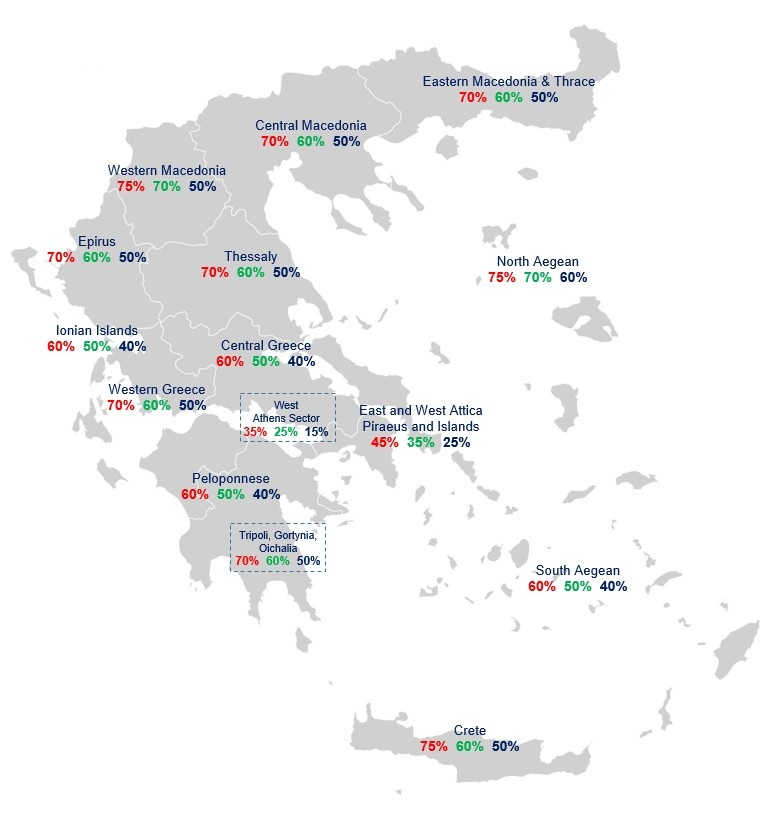
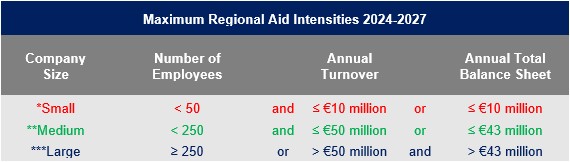
In parallel, the aid rates for eligible costs are determined based on the maximum limits provided by the Regional Aid Map, as presented below.
Aid Intensity and Funding Limits
Aid intensities are determined based on the size of the enterprise and the geographical location of the investment. The basic structure is as follows:
Special rules per incentive type
For micro, small, and medium-sized enterprises, all incentives except grants are provided at the maximum rate of the Regional Aid Map (RAM). Grants, however, are provided at 80% of the maximum RAM rate. In special cases of investment projects, the grant intensity may increase to 90% or even 100% of the maximum RAM rate.
For large enterprises, incentives are generally provided at 80% of the maximum RAM rate, except in special investment cases where they may reach up to 100% of the maximum RAM rate.
Enhanced aid intensity for special investment cases
Higher aid rates apply to investment projects that:
- are implemented in mountainous areas (excluding urban complexes in Attica),
- are located near borders (within 30 km),
- are situated on small islands with fewer than 3,100 inhabitants,
- concern the reactivation of inactive industrial units, provided that the existing fixed assets of the previous facility account for at least 50% of the total investment cost.
Maximum aid ceiling
The maximum amount of public aid that may be granted per investment project is €20,000,000.
Types of Aid
- Tax exemption
- Grant (direct subsidy)
- Subsidy for financial leasing (leasing)
- Subsidy of the cost of newly created employment
Main Categories of Eligible Costs under Regional Aid
Eligible costs of investment projects for which regional aid is granted include the following main categories:
- Investment costs in tangible assets
These mainly concern:
- Building facilities: Costs for construction, expansion, and modernization of buildings, including auxiliary installations, site development works, and accessibility improvements for persons with disabilities.
Limitation: The maximum aid intensity for building-related costs cannot exceed 45% of total eligible regional costs. This percentage increases to 70% for logistics projects (NACE Rev.2 52.29.19.03 / NACE 2025 52.31.19.07).
- Purchase of existing assets (SMEs only): Financing is allowed for the acquisition of buildings, machinery, and equipment from closed or inactive business units, subject to cumulative conditions:
- The facility must have ceased operations.
- The buyer must not be related to the seller (with exceptions for small enterprises acquired by former employees).
- The transaction must take place at market conditions, and any previous aid granted for the same assets must be deducted.
- New machinery and equipment: Includes purchase and installation of new technological equipment, internal transport equipment, and technical installations.
- Leasing of equipment: Eligible leasing payments for new machinery and equipment, provided that ownership is transferred to the beneficiary at the end of the lease period.
- Modernization of specialized installations: Includes upgrades of production or mechanical installations not directly linked to building structures.
2. Investment costs in intangible assets
These relate to technological upgrading and organisational improvement, including:
- Technology transfer: Acquisition of intellectual property rights, licenses, patents, know-how, and non-patented technical knowledge.
- Quality systems and IT systems: Implementation of certification systems, software, and enterprise management systems.
To be eligible, the following conditions must be met:
- Exclusive use within the funded establishment.
- Retention as part of the investment for the entire obligation period.
- Classification as depreciable assets.
- Acquisition from independent third parties at market prices.
Aid limits:
- Large enterprises: up to 30% of total eligible regional aid costs.
- SMEs: up to 50%.
3. Wage cost of newly created jobs
Eligible wage costs cover salaries and employer social contributions for new jobs created exclusively as a result of the investment project, for a period of two years per job. The positions must represent a net increase in employment and must not be financed by other aid schemes.
Eligible Categories of Expenditure Outside Regional Aid
The specific category of expenditure is governed by a different aid intensity compared to regional aid and includes the following types of costs:
- Expenditure for consulting services to SMEs
- Expenditure for energy efficiency measures. Expenditure relating to energy efficiency measures is eligible only when it concerns the additional investments necessary to achieve a higher level of energy efficiency. Anything that does not directly contribute to this objective is not considered eligible. Furthermore, financial support is not granted for projects that merely implement already established and in-force EU compliance standards.
- Expenditure for the installation of efficient district heating and/or cooling systems. Expenditure for the installation of efficient district heating and cooling systems is considered eligible when it concerns the construction or upgrading of a system that is or will become energy efficient. Funding exclusively covers projects that improve or expand such systems. If the system has not yet achieved full energy efficiency due to works in the distribution network, then the additional improvements required to meet energy efficiency criteria must be implemented within three years from the start of those works.
- Expenditure for the remediation of environmental damage, restoration of natural habitats, and ecosystems. In investments relating to the restoration of environmental damage or the reconstruction of natural habitats and ecosystems, eligible expenditure is considered to be the costs related to the relevant remediation or restoration works, after deducting any increase in the value of the land or property resulting from these interventions. Expenditure related to the restoration of areas damaged by natural events such as floods, earthquakes, or fires is not considered eligible, nor is expenditure related to the restoration of sites due to the closure of energy production plants or mining and extractive activities.
- Expenditure for resource efficiency and for supporting the transition to a circular economy. Eligible expenditure refers to the additional investment costs that arise when comparing the total cost of a project with a comparable, less environmentally friendly activity or project, which falls into one of the following categories:
- A counterfactual is a similar investment that could reasonably be implemented either in a new or an existing production process without requiring aid, but which does not ensure the same level of resource efficiency.
- A counterfactual is waste treatment using a method that ranks lower in the waste management hierarchy, as defined in paragraph 1 of Article 4 of Law 4819/2021 (A’ 129), or the treatment of waste, products, materials, or substances in a less resource-efficient manner.
- A counterfactual is an investment in a conventional production process based on primary raw materials or feedstock, where the resulting secondary product—whether reused or recovered—can technically and economically substitute the corresponding primary material.
- Expenditure for vocational training
- Expenditure for SME participation in trade fairs
- Expenditure for hiring workers in disadvantaged positions and workers with disabilities
- Expenditure for investment aid to SMEs
Non-eligible Expenditures
- Operating expenses of the investment
- Purchase of office furniture and equipment, unless it constitutes an essential part of the investment’s production equipment
- Purchase of passenger vehicles with up to six (6) seats
- Purchase of land, plots, and agricultural parcels. In the case of acquisition of buildings, the portion of the expenditure corresponding to the value of the land on which the buildings have been constructed is not eligible for support
- Contribution to share capital in the form of real estate, machinery, or other fixed assets is not considered an eligible expenditure
- Construction or expansion of building facilities on land that is not owned by the investment beneficiary is not considered eligible expenditure, unless the land has been granted by the State or a public sector body, as defined in Article 14 of Law 4270/2014 (A’ 143). Alternatively, eligibility is permitted if the land has been leased from a public or private entity (natural or legal person) or if a right of superficies has been established for the specific purpose. The duration of the lease or superficies right must cover the period specified in point (b) of Article 25 regarding long-term obligations, plus an additional four (4) years from the official completion date of the investment. Such leases may be concluded by private agreement, provided that they are electronically registered with the Independent Authority for Public Revenue and the contract is registered with the competent land registry office or mortgage registry in accordance with applicable legislation.
Scoring Criteria
The scoring criteria of the “Manufacturing – Supply Chain” scheme (Law 4887/2022) are divided into four evaluated groups, as set out below:
Group A: Evaluation of Project Maturity (score 0–42)
Factors demonstrating the readiness of the investment for implementation are assessed, such as:
- Availability of the installation site.
- Submission of applications for environmental licensing, preliminary approval and building permit issuance, as well as applications for revision or installation permit.
- Priority is given to organized reception areas.
- Next in priority are designated areas that do not yet have full licensing.
- Finally, installations outside these areas receive a lower score.
Group B: Evaluation of the Financial Data of the Entity (score 0–25)
The assessment varies depending on whether the entity is existing or new:
- For existing entities, financial ratios are calculated based on the average values of financial data recorded in the financial statements of the two (2) most recently closed financial years prior to the application for inclusion.
- For new entities, the assessment is based on the financial data of their shareholders/partners from the two most recently closed financial years, as follows:
- Shareholders/Partners that are legal entities: If they hold more than 25% participation in the investment entity, the financial data of the two most recent financial years of the companies in which they participate are taken into account cumulatively.
- Shareholders/Partners that are natural persons with participation in other companies: If they hold more than 25% in the investment entity and more than 25% in other companies, then the financial data of those companies are also included cumulatively.
- Shareholders/Partners that are natural persons exercising management: If they hold more than 25% in the investment entity and do not hold more than 25% participation in other companies, but have exercised executive management (e.g. CEO, Executive Chairman) in other companies for at least 6 months per year, then the financial data of those companies are also taken into account.
Group C: Evaluation of Sustainable Development Elements (score 0–18)
The scoring of Group C is based on two main criteria:
- STEP Seal indicator: The existence of certifications related to environmental management, social responsibility, and sustainable development is assessed.
- Export orientation indicator: The average export percentage of the company is calculated based on the two most recently closed financial years prior to the application. The higher the export percentage, the higher the score.
Group D: Evaluation of Employment Increase (score 0–15)
The score in this group is determined by the number of new dependent employment positions expected to be created by the investment project, in relation to the total eligible investment cost (calculated per thousand euros). The more jobs the investment creates relative to its cost, the higher the score.
Project Submission Period, Method, and Implementation Duration
The application period for inclusion in the present aid scheme began on 17 April and ends on 30 June 2026. Applications are submitted through the Investment Incentives Information System and are filed with the following competent authorities:
- For investment projects with a budget ranging from €1.000.000 to €3.000.000 implemented in the Regions of Macedonia and Thrace, applications are submitted to the Directorate of Private Investments of the Ministry of Interior, Macedonia–Thrace Sector.
- For all other investment projects, applications are submitted to the General Directorate of Development Laws and Foreign Direct Investments of the General Secretariat for Private Investments of the Ministry of Development.
For further information regarding the new “Manufacturing – Supply Chain” aid scheme under the updated Development Law 4887/2022 and the planning of your investment projects, you may contact us at +30 231 0 552000 and +30 210 9580000 or via email at [email protected].