




Information Note on the Action “Business Initiative Sterea (Central Greece)” total budget of 12 million euro

Introduction
The Action “Business Initiative Sterea (Central Greece)” is implemented within the framework of strengthening productive and manufacturing activity in Central Greece, aiming to enhance the competitiveness of enterprises and support investments that increase the added value of domestic production. Through the financing of interventions in equipment, technological upgrading, and improvements in production processes, the Action seeks to reinforce the sustainability of small and medium-sized enterprises and contribute to the development of a more modern and outward-looking production model at regional level. The Action is co-financed by Greece and the European Regional Development Fund (ERDF). It is included in the “Central Greece” 2021–2027 Programme and, in particular, under Priority 1, “Enhancing the competitiveness and outward orientation of the economy through the promotion of innovative and smart transformation.” The total public expenditure of the Action amounts to €12.000.000,00, with the possibility of approvals up to €16.000.000,00.
Eligible Beneficiaries
Eligible beneficiaries must be existing Micro, Small and Medium-sized Enterprises (SMEs), as defined by the European Commission, seeking to enhance their competitiveness through the modernisation of their productive and operational base. In this context, the Action aims to support investments that leverage modern technologies and innovative methods, strengthen the outward orientation of enterprises, and contribute to improving their environmental performance. At the same time, it promotes energy efficiency and the adoption of circular economy principles, with the objective of transitioning towards more sustainable and efficient production and business models.
Basic Eligibility Requirements:
The fundamental eligibility conditions for prospective beneficiary enterprises relate to specific criteria concerning both their operational status and the characteristics of the investment plan. In particular, enterprises must cumulatively meet the following core requirements:
- They must be existing enterprises with a commencement date registered with the Independent Authority for Public Revenue (AADE) prior to 30/06/2023 and must have at least two fully closed financial years (2023 and 2024).
- They must have been active during 2024 and up to the date of application submission in at least one eligible NACE code (KAD), as defined in the call.
- The investment plans must have an integrated nature and concern exclusively one sector of the National Smart Specialisation Strategy (RIS3).
For investment plans related to NACE code 55 “Accommodation” within the Tourism sector, the following key conditions apply at the completion and final verification stage:
- Main hotel establishments: minimum category of 3 stars and at least 8 beds.
- This category also includes hotels in traditional buildings and heritage architecture buildings, as well as organised campsites (campings) of at least 3 stars.
- Non-main hotel accommodation: rented rooms of at least 3 keys with a minimum capacity of 8 beds.
- Tourist furnished residences: minimum requirement of 3 residences under a single operating licence (ESL) or notification.
- In case of capacity expansion (excluding campsites): upgrading to at least 4 stars or 4 keys is required, with a minimum of 8 beds.
- For campsites: expansion is permitted without an obligation to upgrade classification.
- For new accommodation units: a minimum classification of 4 stars or 4 keys and a minimum capacity of 8 beds is required.
Eligible Budget
The eligible grant budget varies depending on the aid scheme selected by the beneficiary. Specifically, under Regulation (EU) 2023/2831 (de minimis), the minimum eligible budget per investment project is set at €30.000 and may reach up to €400.000. Correspondingly, under Regulation (EU) 2014/651 (General Block Exemption Regulation – GBER), as in force, the eligible budget range is set from €200.000 to €800.000, enabling the implementation of larger-scale investment projects.
Intensity and Level of Aid
The intensity of the aid varies depending on the size of the enterprise (micro, small, or medium) and the applicable aid scheme.
- Under Regulation (EU) 2023/2831 (de minimis), the public funding rate is set at 70% for all categories of expenditure and irrespective of SME size, with private participation amounting to 30%. For investment projects that include expenditure on energy upgrading, energy savings, or environmental protection representing at least 20% of the total budget (“green projects”), the aid intensity is increased by 5% and rises to 75%, with a corresponding reduction of private participation to 25%.
- Similarly, under Regulation (EU) 2014/651 (General Block Exemption Regulation – GBER), the aid intensity varies both by expenditure category and by enterprise size. For medium-sized enterprises it typically ranges from 40% to 50%, while for small and micro enterprises it ranges from 50% to 60%, depending on the applicable article and the type of eligible expenditure. Private participation is correspondingly adjusted, reaching up to 60% for medium-sized enterprises, while for smaller enterprises it is lower, depending on the specific expenditure category and the relevant provision of the GBER.
Eligible Expenditure
The start date of expenditure eligibility is defined as the date of electronic submission of the funding application, regardless of the applicable aid scheme. Any expenditure incurred or any contracting undertaken prior to this date is deemed ineligible, with different implications depending on the applicable framework: under the de minimis regime (Reg. (EU) 2023/2831), such expenditure is rejected, whereas under the GBER regime (Reg. (EU) 2014/651), as in force, pre-start of works results in the loss of the incentive effect and consequently in the ineligibility of the entire investment project.
The end date of expenditure eligibility is defined as the completion of the project, which is set within twenty-four (24) months from the date of electronic notification of the final approval of the funding application, and in any case no later than 31/12/2029. Eligible expenditure categories include:
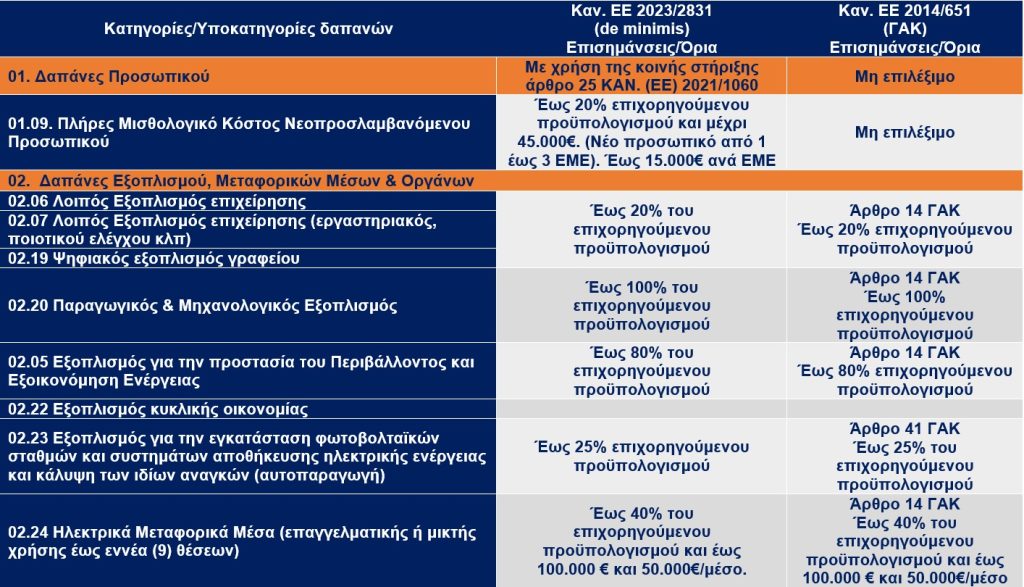
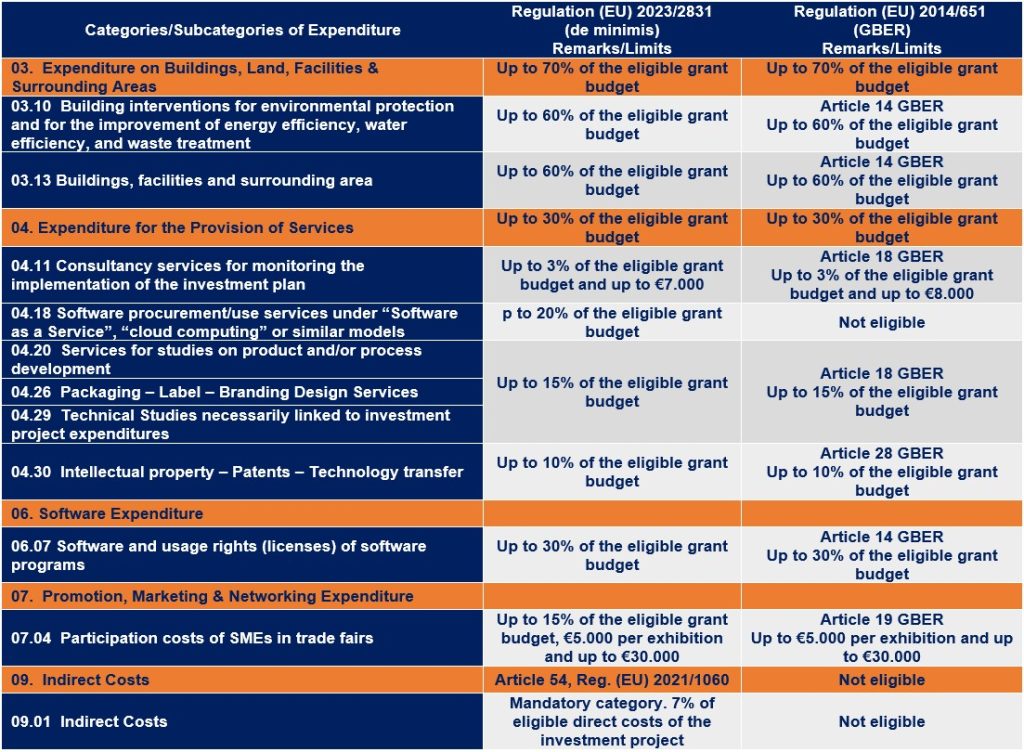
Scoring Criteria
The evaluation criteria of the Action, along with the scoring methodology and weighting factors, are summarised as follows:
- The first criterion functions as an eligibility filter under Regulation (EU) 2014/651 (GBER) and is not assigned any score or weighting factor. It examines compliance with the fundamental requirements of the Regulation, including the incentive effect, the concept of initial investment, as well as the required commitments (separation of activities, avoidance of relocation where applicable, and a minimum private contribution of 25%). The outcome is binary (“YES” or “NO”).
- B1 – Available capital: score 0–100, weighting factor 20% (B1 > 0). This criterion assesses the financial adequacy of the enterprise, namely the degree to which the total eligible budget is covered by own funds, borrowing, or a combination thereof. The indicator is calculated as: Available Capital / Total Eligible Budget × 100. The higher the secured financing, the higher the score.
- B2 – Turnover growth rate: score 0–100, weighting factor 20%. This criterion evaluates the growth dynamics of the enterprise through the change in turnover between 2023–2024. A positive evolution (increase in turnover) results in a higher score.
- B3 – Operating profitability (EBITDA): score 0–100, weighting factor 15%. This criterion assesses the operational efficiency of the enterprise through the EBITDA-to-turnover ratio.
- B4 – Employment (FTEs): score 0–100, weighting factor 10%. This criterion evaluates the existing employment level of the enterprise, expressed in Full-Time Equivalents (FTEs). A higher number of employees leads to a higher score.
- B5 – Completeness and maturity of the investment plan: score 0–100, weighting factor 20% (B5 > 0). This is a qualitative criterion assessing the coherence, clarity, and realism of the investment plan.
- B6 – Innovation / environmental impact: score 0–100, weighting factor 15%. This criterion evaluates the degree of innovation and/or environmental contribution of the investment.
The final score is calculated as the sum of the weighted individual scores (score × weighting factor), and for inclusion a minimum score of ≥ 30 points is required.
Application Period, Submission Method and Implementation Duration of Investment Projects
The opening date for the electronic submission of funding applications via the Integrated State Aid Information System (ISKS) is set for Monday, 18 May 2026 at 15:00, with a submission deadline on Friday, 18 September 2026 at 15:00. Applications that are not submitted electronically shall not be eligible for funding.
Following the expiry of the submission date and time, no application submissions shall be accepted. Funding applications shall be submitted exclusively through the Integrated State Aid Management Information System (ISKS).
The evaluation will be carried out using a comparative assessment methodology. In order to be eligible for submission and evaluation, each funding application must achieve a minimum score of 30 points.
For further information regarding the Action “Business Initiative Sterea (Central Greece)” and the planning of your investment projects, you may contact us at +30 231 552000, +30 210 9580000, or via email at [email protected]