





Up to 75% Subsidy: The “Special Support Areas” Scheme of Development Law 4887/2022 has been announced, with a total budget of €150.000.000.
Introduction
The “Special Support Areas” Scheme (2nd Cycle) under Development Law 4887/2022 aims to substantially support investment projects implemented in regions of the country that face serious economic and demographic challenges. More specifically, the Scheme covers:
a. Border regional units located along the northern borders of the country,
b. Areas where the per capita Gross Domestic Product (GDP) does not exceed 70% of the national average or that exhibit significant population decline as a result of adverse economic and social conditions.
The regional units included within the scope of this Scheme are the following:
- Lesvos–Lemnos
- Ikaria–Samos
- Chios
- Evros
- Xanthi
- Rhodope
- Drama
- Kilkis
- Pieria
- Serres
- Florina
- Grevena
- Kastoria
- Ioannina
- Thesprotia
- Arta
- Preveza
- Karditsa
- Trikala
- Magnesia
- Larissa
- Ilia
- Evrytania
- Phocis
- The following islands of the South Aegean: Kasos, Megisti, Chalki, Symi, Nisyros, Pserimos, Tilos, Lipsi and Agathonisi, as well as the island of Ammouliani.
- The Regional Unit of Kozani, designated as the “Kozani De-lignitisation Zone”.
- The Municipality of Megalopolis in the Regional Unit of Arcadia, Peloponnese Region, designated as the “Megalopolis De-lignitisation Zone”.
- The Regional Unit of Pella.
The total budget of this Scheme amounts to €150.000.000, of which €75.000.000 is allocated to tax exemptions.
The remaining €75.000.000 is allocated to grants, leasing subsidies, and subsidies for employment costs.
Funding is provided through the Public Investment Budget of the Ministry of Development.
Eligible Investment Projects
Under this Scheme, eligible investment projects are those implemented in the designated areas and relate to the following categories:
Production investments by enterprises of all sizes (large, medium, small and micro, as well as start-ups), aiming at:
- Economic diversification, i.e. the expansion or transformation of the range of products or services produced, in order to reduce dependence on a single sector or market.
- Modernisation of production processes and infrastructure.
- Economic growth, i.e. an increase in production capacity, turnover, or profitability.
Investments for the establishment of new enterprises, which are directly linked to the creation of new jobs, a critical factor for strengthening local employment.
Circular economy investments, which:
- Contribute to waste prevention,
- Enhance the efficient use of natural resources,
- Include reuse, repair, and recycling of materials,
- And fall under specific Activity Classification Codes (NACE codes) defined and published by the Ministry of Development.
Key Requirements for Investment Inclusion
Investment projects must have a comprehensive “initial investment” character, meaning they must involve the introduction of new production capacities and not merely the renewal or replacement of existing assets.
Specifically, the investment must include at least one of the following actions:
- Establishment of a new facility (new unit): Creation of an entirely new production unit in a given area.
- Expansion of an existing production unit: Increase in production capacity through the addition of new equipment or production lines.
- Diversification of production: Production of new products or provision of new services that have never previously been produced or offered by the existing unit. In this case, eligible costs must be at least 200% higher than the book value of reused assets.
- Fundamental change in the production process: Modernisation that radically transforms the production method. For large enterprises, eligible costs must exceed the depreciation of the last three years related to the modernised activity, ensuring substantial upgrading.
Important clarification: Replacement investments of old equipment are not considered initial investments. The acquisition of shares in another enterprise is also excluded from this scheme.
Within the framework of the current aid regime, specific rules and conditions apply to investment projects in the sectors of agricultural product processing, logistics services, and tourism.
- Processing of Agricultural Products
When an investment concerns the processing of agricultural products without resulting in a new agricultural product, aid applies only to the processing activity. In other words, only the transformation process is subsidised, not primary production.
2. Transport Services and Logistics
For supply chain management services (logistics – NACE code 2008 52.29.19.03 / NACE code 2025 52.31.19.07) provided to third parties, services may also be offered to group companies, up to 30% of total services. Facilities used for these services must be clearly distinct and not mixed with other business activities of the same company or group. A prerequisite for establishing or upgrading logistics units is the installation of integrated IT and telematics systems supporting warehouse and cargo handling management.
3. Tourism Sector
Tourism investment projects are limited to specific areas such as the North Aegean, Samothraki, and the islands of Kasos, Megisti, Chalki, Symi, Nisyros, Pserimos, Tilos, Lipsi, Agathonisi, as well as Ammouliani. The total aid intensity for tourism may not exceed 15% of the scheme’s total public funding. Eligible projects include:
- Establishment or expansion of hotels of at least 4 stars.
- Modernisation of 3-star (and above) hotels operating for more than 5 years since the last investment or since commencement of operations.
- Expansion or upgrading of hotels that have been closed for at least 2 years, provided the building use has not changed and they are upgraded to at least 4 stars.
- Establishment, expansion, or modernisation of organised camping sites (at least 3 stars).
- Establishment or modernisation of hotels in traditional or listed buildings, upgraded to at least 3 stars.
- Establishment of Glamping tourism accommodation (luxury outdoor camping facilities).
Excluded Sectors
The Scheme does not apply to:
- Fisheries and aquaculture.
- Primary agricultural production.
- Sectors excluded under Article 1 of the General Block Exemption Regulation (GBER).
- Sectors excluded from regional aid under Article 13 of the GBER.
Eligible Beneficiaries
Beneficiaries of this Scheme are investment entities that either already operate or intend to commence their activity within the Greek territory at the time the implementation works of their investment project begin.
The main categories of beneficiaries are:
- Commercial companies, regardless of size and legal form, such as:
- Societés Anonymes (S.A.)
- Limited Liability Companies (L.L.C.)
- Private Companies (P.C.)
- General Partnerships (G.P.) and Limited Partnerships (L.P.)
- Other forms of commercial companies provided for under Greek law
- Cooperatives, regardless of sector of activity
- Special forms of corporate schemes in the primary and social sectors, such as:
- Social Cooperative Enterprises
- Agricultural Cooperatives (A.C.)
- Producer Groups (P.G.)
- Urban Cooperatives
- Agricultural Corporate Partnerships (A.E.S.)
- Companies under merger, subject to the strict condition that all required publicity procedures have been completed prior to the commencement of the investment project works
- Consortia, provided that they carry out commercial activity
- Public and municipal enterprises, as well as their subsidiaries, under the following strict conditions:
- They must not have undertaken the provision of a public service purpose
- They must not have been assigned exclusive service execution by the State
- Their operation must not be subsidised by public funds during the period in which they are subject to the long-term obligations under the investment law
Non-Eligible Enterprises (Exclusions)
The following categories of enterprises are explicitly excluded from participation in the Scheme:
- Enterprises subject to recovery procedures for state aid, based on previous decisions of the European Commission (Deggendorf principle), at the time of application submission.
- Undertakings in difficulty, as defined in paragraph 18 of Article 2 of the General Block Exemption Regulation (GBER), with assessment carried out both at the level of the applicant company and at group level.
- Enterprises that have relocated, or refuse to commit that they will not relocate, the business establishment where the initial investment is to be implemented:
- if the relocation took place within two (2) years prior to the submission of the application, or
- if they refuse to commit that they will not transfer the establishment to another EU Member State for a period of at least two (2) years after the completion of the investment.
- Enterprises implementing investment projects on behalf of the State, arising from public works contracts, concession agreements, or service provision contracts.
- Enterprises subject to pending recovery of state aid at the time of submission of the investment application.
- Enterprises against which sanctions have been imposed for violations of labour legislation (Article 40 of Law 4488/2017 (Government Gazette A’ 137), concerning exclusion of potential beneficiaries from aid schemes).
Core Participation Requirement for Potential Beneficiaries – Incentive Character
The aid granted under this Scheme operates as a genuine incentive for the realization of investments, provided that the beneficiary submits a written application for inclusion prior to the commencement of any work or action related to the investment project. This means that the submission of the application is a fundamental prerequisite in order for the aid to be considered as having contributed to the implementation of the investment.
If the beneficiary has already started the investment works before submitting the application, the application is automatically considered inadmissible and is rejected. Furthermore, even if it has initially been approved, the decision may be revoked by the competent authorities, regardless of the stage of implementation of the investment, if it is established that the commencement of works preceded the submission of the application.
The above process is subject to verification within a specific timeframe following the completion of the investment, in order to ensure that the aid scheme functions properly as an incentive mechanism and that subsidies are not granted to projects that have already started without prior approval.
Project Budget, Aid Intensity and Level of Support
For inclusion in this aid scheme, a minimum eligible investment cost threshold is set as a fundamental requirement. Specifically, each submitted investment project must have total eligible expenditures of at least €2.000.000.
The maximum amount of public aid per investment project amounts to €20.000.000, subject to lower ceilings provided for under Article 4 of the General Block Exemption Regulation (GBER).
At enterprise level, total cumulative aid may not exceed €20.000.000 for a single undertaking and €50.000.000 for a group of cooperating or linked enterprises, within a three (3) year period from the date of submission of the application for inclusion.
The ceiling is calculated based on the amount of aid approved in the inclusion decision. In the event of an overrun, the excess amount is proportionally reduced per aid category and per group of eligible expenditures.
The above limits are increased by 50% when the aid is granted in the form of tax exemption, provided that the restrictions of the GBER are fully respected.
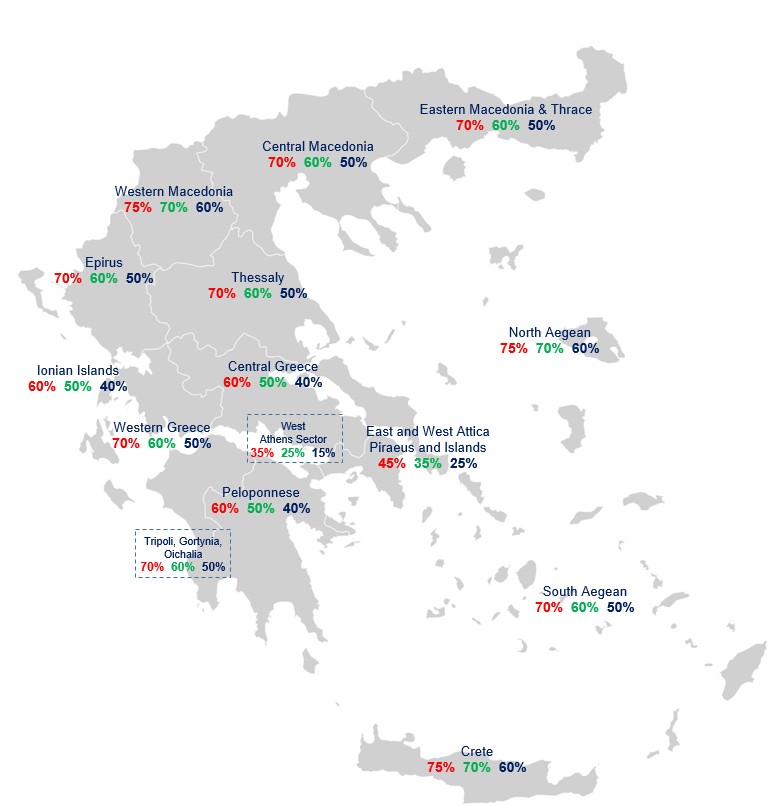
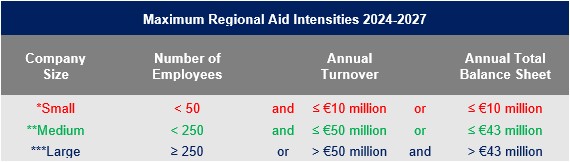
Aid intensities for eligible expenditures are determined according to the maximum limits set by the Regional Aid Map, as presented below.
Conditions and Restrictions
- Removal of SME intensity bonuses for large projects: The increased aid intensities provided under the Regional Aid Map (RAM) for Small and Medium-sized Enterprises do not apply to investment projects with eligible costs exceeding €55.000.000. The same applies to non-regional aid expenditures under Article 7.
- Flexibility in “a-type” areas (TFEU Article 107(3)(a)): In areas subject to a special aid status (so-called “a” areas under the Treaty on the Functioning of the European Union), aid is granted regardless of enterprise size, provided that the investment qualifies as an initial investment.
- Special degressive aid scale for large investment projects (> €50.000.000):
- For the portion up to €55.000.000, 100% of the maximum regional aid ceiling applies (without SME bonus).
- For the portion from €55.000.001 up to €110.000.000, 50% of the maximum regional aid ceiling applies.
- For the portion exceeding €110.000.000, no aid is granted.
Types of Aid
Within the framework of this Scheme, investment projects may benefit from the following types of support:
- Tax exemption
- Exemption from income tax on the pre-tax profits of the enterprise.
- Calculated as a percentage of the eligible investment cost or the value of new equipment (including through leasing).
- The corresponding amount is recorded in a special reserve account in the company’s financial statements.
- Grant – Direct financial aid
- Direct non-repayable financial support from the State.
- Granted as a percentage of the eligible costs of the investment project.
- Constitutes non-repayable capital support.
- Leasing subsidy
Coverage of part of the instalments of financial leasing agreements related to the acquisition of new machinery or other equipment.
-
- The subsidy duration may extend up to 7 years.
- Eligibility begins from the completion date of the investment.
- Subsidy for new employment costs
Coverage of part of the wage cost for new jobs created within the investment project.
-
- Applies only to positions directly linked to the investment.
- These costs cannot be simultaneously financed by other state aid schemes.
Important Clarifications: Tax exemption, grant, and leasing subsidy may be granted either individually or in combination, provided that the total aid ceiling per investment project is respected. Employment subsidies are granted separately and exclusively for new jobs and only for the corresponding wage cost.
Fast-Track Licensing Incentive
Within the framework of the Scheme, a special fast-track licensing procedure is provided for investments falling under the aid regime.
Following the submission of a complete file by the investor to the General Directorate of Development Laws and Foreign Direct Investments, all required permits and approvals (including environmental and spatial planning permits) must be issued within two (2) months. If additional information is required, the administration may request supplementary elements, thereby “suspending” the deadline until such information is submitted.
The procedure is handled with absolute priority. In the event that the deadline is exceeded, competence is transferred to the Minister of Development, who is required to issue a decision within one (1) month. The General Secretariat for Private Investments is also designated as a competent licensing authority.
This fast-track licensing mechanism is designed to significantly reduce permitting delays, limit administrative uncertainty, and strengthen investor confidence. It ensures a more predictable and investor-friendly regulatory environment, with clear deadlines, institutional accountability, and defined intervention mechanisms in case of delays. The strategic objective is the immediate commencement of investment implementation without unjustified administrative barriers, thereby enhancing the country’s overall attractiveness as an investment destination.
Eligible Cost Categories of Regional Aid
Eligible costs for investment projects for which regional aid is granted, subject to specific terms and conditions, are as follows:
- Investment costs in tangible assets:
Construction, expansion, and modernization of building facilities: This includes main and auxiliary installations, accessibility for persons with disabilities, and site development works.
Cost limits: up to 45% of total eligible regional aid costs.
Special cases:
-
- 70% for logistics investments (code 52.29.19.03).
- 80% for listed/protected buildings.
Construction works legalized under laws 1337/1983, 4178/2013, and 4495/2017 are also eligible, provided legalization is completed.
For tourism investment projects, the ceiling increases to 60%.
Purchase of existing fixed assets.
Conditions apply:
-
- The business facility has ceased operations.
- The buyer is not related to the seller (with limited exceptions).
- The transaction is at market conditions.
- Assets already subsidized are excluded.
Purchase and installation of new machinery and equipment, including technical installations and internal transport equipment.
Leasing payments for new machinery and equipment, provided ownership is transferred at the end of the contract.
Modernization of special mechanical installations not related to buildings.
Accessibility improvement costs for persons with disabilities.
2. Investment costs in intangible assets:
Technology transfer: purchase of intellectual property rights, licenses, patents, know-how.
Quality systems, certifications, software, and enterprise management systems.
Limits:
-
- Large enterprises: up to 30% of total eligible costs.
- SMEs: up to 50%.
Conditions:
-
- Exclusive use in the funded investment.
- Retention during the obligation period.
- Depreciation under accounting rules.
- Purchase from unrelated third parties.
- Tourism facilities and campsites modernization:
Defined by relevant ministerial decisions (43965/30-11-1994 and 58692/05-08-1998) as applicable.
- Wage cost of new jobs:
Eligible for two (2) years per job created and treated separately from other investment costs.
Conditions:
- Net increase in employment (measured in Full-Time Equivalents).
- Jobs must be created within three (3) years after project completion.
- Retention periods:
- 5 years for large enterprises
- 4 years for medium enterprises
- 3 years for small enterprises
Eligible Cost Categories Outside Regional Aid
Investment projects under this scheme may receive additional support — beyond regional incentives — for specific categories of costs as set out below:
- Consulting services for Small and Medium-sized Enterprises (SMEs)
Eligible costs include external consultancy services for the preparation of investment studies and general support for new SMEs. Routine operational services (such as accounting, tax, legal, or advertising services) are explicitly excluded. A “new enterprise” is defined as one that has not completed a 12-month financial year at the time of application submission.
- Energy Efficiency Measures (excluding buildings)
Only additional costs that lead to a substantial improvement in energy efficiency of equipment or processes are eligible, excluding buildings (in accordance with Article 38 of the GBER). Investments aimed at compliance with already existing EU standards are not eligible. Exception: investments required to meet future standards, provided they are completed at least 18 months before those standards enter into force.
- Environmental Damage Remediation and Habitat Restoration
Eligible costs include remediation works or restoration of natural ecosystems. Important condition: projects related to natural disasters or the closure of energy plants/mines are not supported. The “polluter pays” principle remains a core eligibility criterion.
- Resource Efficiency and Circular Economy
Eligible costs include additional investments required to improve resource efficiency or support the transition to a circular economy. The undertaking must demonstrate that the cost exceeds that of a less environmentally friendly alternative (baseline scenario), based on clearly defined parameters (Article 47 of the GBER).
- Vocational Training of Personnel
Eligible costs include upskilling or reskilling of staff. These may include trainers’ fees, travel and accommodation expenses, training materials, depreciation of equipment, and a portion of trainees’ wage costs for the hours spent in training. Training required by mandatory national occupational standards is excluded.
- Employment of Disadvantaged and Disabled Workers
Eligible costs cover wage expenses for up to 12 months (or up to 24 months for particularly disadvantaged workers), subject to conditions of net employment increase.
- Innovation in SMEs
Eligible costs include:
-
- Patent rights and protection of intangible assets
- Secondment of highly qualified personnel from research organisations or large enterprise
- Consultancy and support services related to innovation
- Process and Organisational Innovation for SMEs and Large Enterprises
Eligible costs include:
-
- Personnel costs
- Equipment, buildings and land used exclusively for the project
- Contract research, acquisition of know-how and licensing rights
- Operating costs and materials directly linked to the project
- High-efficiency cogeneration from RES and renewable energy production
Only projects selecting the grant as the form of aid are eligible. Eligibility is governed by Article 47 of the GBER.
Non-Eligible Costs
- Operating expenses
- Purchase of office furniture and utensils, unless they form part of hotel equipment or are an essential component of the production equipment of the investment
- Purchase of passenger vehicles up to 6 seats
- Purchase of land, plots, and agricultural land
In the case of building acquisition, the corresponding value of the land is not eligible for subsidy.
- Contribution of real estate, machinery, and other fixed assets to share capital is not considered an eligible cost, as it does not constitute new investment expenditure.
- Construction or expansion of buildings on land not owned by the investor
Eligible only if:
- The land is granted by the State or a General Government entity (Law 4270/2014, Article 14), or
- A legally valid long-term lease exists (for a duration sufficient to cover the long-term obligations of the project plus 4 years after completion), or
- A right of surface is established with the same temporal coverage.
The lease must:
- Be registered in the Land Registry or recorded at the Mortgage Registry
- Be declared electronically to the Independent Authority for Public Revenue (AADE)
- Acquire legal validity in accordance with Article 618 of the Civil Code (enforceability against third parties)
Scoring Criteria
The scoring criteria of the “Special Aid Regions” scheme (Law 4887/2022) are divided into four evaluated groups, as follows:
Group A: Assessment of Project Maturity (score 0–45)
Factors demonstrating the readiness of the investment for implementation are examined, such as:
- Availability of the installation site.
- Submission of applications for environmental licensing, preliminary approval and issuance of building permits, as well as applications for installation permits.
- Priority is given to organized industrial/business parks.
- Next come designated areas without full licensing.
- Finally, installations outside such areas receive lower scores.
Group B: Financial Assessment of the Entity (score 0–25)
The assessment differs depending on whether the entity is existing or new:
- For existing entities, financial ratios are calculated based on the average values from the last two (2) completed financial years prior to the application submission.
- For new entities, the assessment is based on shareholders/partners’ financial data from the last two completed financial years, as follows:
- Corporate shareholders/partners: If they hold more than 25% in the investment entity, the combined financial data of the companies in which they participate over the last two years is taken into account.
- Individual shareholders/partners with participation in other companies: If they hold more than 25% in the investment entity and more than 25% in other companies, the financial data of those companies are aggregated.
- Individuals exercising management roles: If they hold more than 25% in the investment entity and do not hold significant shares in other companies, but have served in executive management positions (e.g. CEO, Executive Chairman) in other companies for at least 6 months per year, the financial data of those companies is also included.
Group C: Sustainable Development Criteria (score 0–10)
The score is based on three main criteria:
- STEP Seal Index: Assessment of certifications related to environmental management, social responsibility, and sustainability.
- Export Orientation Index: Average export percentage over the last two completed financial years; higher export levels result in higher scores.
- Tourism-specific criteria only:
- Sustainability certification (LEED): whether the investment includes environmental certification.
- Operating model: whether the facility operates year-round or seasonally.
- Thematic specialization: e.g. gastronomic, spa, conference, sports tourism, etc.
Group D: Employment Growth Assessment (score 0–20)
The score is based on the number of new dependent employment positions created by the investment, relative to the total eligible investment cost (calculated in thousands of euros).
The more jobs created in relation to the investment size, the higher the score.
Application Period, Submission Method and Implementation Duration of Investment Projects
The application period for submitting investment projects under this aid scheme starts on 17 April 2026 and ends on 30 June 2026. Applications are submitted through the Information System of Development Laws and are filed with the following competent authorities:
For investment projects with a budget of up to €3,000,000 implemented in the Regions of Western Macedonia, Central Macedonia, and Eastern Macedonia and Thrace, applications are submitted to the Directorate of Private Investments of the Ministry of Interior, Macedonia–Thrace Sector.
For all other investment projects, applications are submitted to the General Directorate of Development Laws and Foreign Direct Investments of the General Secretariat for Private Investments of the Ministry of Development.
For further information regarding the new incentive scheme “Special Support Areas” of the updated Development Law 4887/2022 and the planning of your investment projects, you may contact us at +30 231 0 552000 and +30 210 9580000 or via email at [email protected].