





“Agri-Food – Primary Production and Processing of Agricultural Products – Fisheries – Aquaculture” Development Law 4887/2022 with total budget of 150 million €

Introduction
The second cycle of the “Agri-Food – Primary Production and Processing of Agricultural Products – Fisheries – Aquaculture” aid scheme has been launched. The scheme aims to support business activities relating to primary agricultural production, the processing of agricultural products, fisheries and aquaculture.
The scheme’s total budget for 2026 amounts to EUR 150 million. Of this amount, EUR 75 million is available in the form of tax exemption. The remaining EUR 75 million concerns grants, financial leasing subsidies and subsidies for the cost of new jobs, financed through the Public Investment Budget of the Ministry of Development and Investments.
Eligible Beneficiaries and Participation Requirements
Eligible beneficiaries are investment entities established in Greece, or maintaining a branch in Greece at the time works commence on the investment plan, and having one of the following legal forms:
- Commercial companies (S.A., Ltd., Private Company, General Partnership, Limited Partnership, etc.).
- Cooperatives.
- Social Cooperative Enterprises, Agricultural Cooperatives, Producer Groups, Urban Cooperatives and Agricultural Corporate Partnerships.
- Companies undergoing merger, provided that the required publicity procedures have been completed before works on the investment plan begin.
- Joint ventures carrying out commercial activity.
- Public and municipal enterprises and their subsidiaries, provided that they have not been entrusted with a public-service mission, have not been granted an exclusive state mandate to provide services, and their operation is not subsidised from public resources during the period in which long-term obligations must be maintained.
The scheme covers investment plans concerning primary agricultural production and the processing of agricultural products. Vertically integrated investment plans combining primary production and processing are also eligible, provided that both parts are implemented in the same Regional Unit and are presented as two distinct sections.
To qualify, the investment activity must fall within the eligible Activity Code Numbers (KAD/NACE codes) to be specified by the Ministry of Development. Although fisheries and aquaculture appear in the scheme title, this specific call does not provide support for investment plans in those sectors.
Ineligible Undertakings (Exclusions)
The following categories are expressly excluded:
- Undertakings subject to a recovery order for unlawful or incompatible aid under a previous European Commission decision (Deggendorf principle) at the time the application is submitted.
- Undertakings in difficulty within the meaning of Article 2(18) of the General Block Exemption Regulation, assessed both at applicant and group level.
- Undertakings that have relocated, or refuse to undertake not to relocate, the business establishment in which the initial investment will be implemented, where relocation occurred during the two years
- preceding the application, or where they refuse to commit not to transfer the establishment to another EU Member State for at least two years after completion of the investment.
- Undertakings implementing investment projects on behalf of the State under works, concession or service contracts.
- Undertakings against which aid recovery is pending at the time the investment-plan application is submitted.
- Undertakings sanctioned for infringements of labour legislation under Article 40 of Law 4488/2017 concerning exclusion of potential beneficiaries from aid schemes.
The eligible forms of investment projects are as follows:
- Establishment of a new production facility.
- Expansion of the production capacity of an existing establishment (facility).
- Diversification of the output of an existing establishment (facility): This form of investment involves the introduction of products or services that have not previously been produced or provided by the establishment concerned, provided that the eligible costs exceed by at least two hundred per cent (200%) the book value of the assets being reused, as recorded in the financial year preceding the submission of the application for inclusion of the investment project under the aid scheme.
- Fundamental change in the overall production process: Investments involving a substantial modernisation of the production process. In the case of large enterprises, an additional condition applies: the eligible costs must exceed the depreciation of the assets associated with the activity to be modernised over the three preceding financial years. Where the depreciation of the assets associated with the relevant activity cannot be clearly identified, the above condition shall be deemed not to have been met.
- Acquisition of assets belonging to an establishment that has closed or would have closed had it not been purchased: This option is available only to small and medium-sized enterprises. The mere acquisition of the shares of an undertaking does not constitute an initial investment.
Key Eligibility Requirement for Potential Beneficiaries – Incentive Effect
Aid granted under this scheme shall be deemed to have an incentive effect only where the investor has submitted a written application for inclusion under the scheme before work on the investment project begins. Submission of the application before the undertaking of any binding commitment is a fundamental condition for the investment’s eligibility.
Where work on the investment project has commenced before the application is submitted, the application shall be rejected. Even where a decision approving the project’s inclusion under the scheme has already been issued, that decision may be revoked, irrespective of the stage of implementation, if it is established that work began before the application was submitted.
The start of works shall mean the earlier of either the commencement of construction works or the first legally binding commitment, such as the ordering of equipment or any other commitment that renders the investment irreversible. By contrast, the purchase of land and preparatory activities, such as obtaining permits and carrying out feasibility studies, shall not be regarded as the start of works.
In the case of the acquisition of an establishment, the start of works shall be deemed to occur upon the acquisition of the assets directly linked to that establishment.
Προϋπολογισμός έργου, ύψος και ένταση Ενίσχυσης
The minimum eligible investment amount is determined on the basis of the size of the undertaking or the type of entity submitting the proposal. More specifically, the following thresholds apply:
- Large enterprises: the minimum eligible investment amount is set at €1,000,000. Investment projects with a lower budget are therefore not eligible for funding under this scheme.
- Medium-sized enterprises: investment projects must have a minimum eligible budget of €500,000 in order to meet the eligibility requirements.
- Small enterprises: the minimum eligible investment amount is €250,000, whereas microenterprises must submit investment projects with a budget of at least €100,000.
- Special provision is made for social economy entities, such as Social Cooperative Enterprises (Koin.S.Ep.), Agricultural and Urban Cooperatives, Producer Groups and Agricultural Corporate Partnerships, which may submit investment projects with a minimum budget of €50,000.
At the same time, the aid rates applicable to eligible expenditure are determined on the basis of the maximum aid intensities laid down in the Regional Aid Map, as illustrated below.
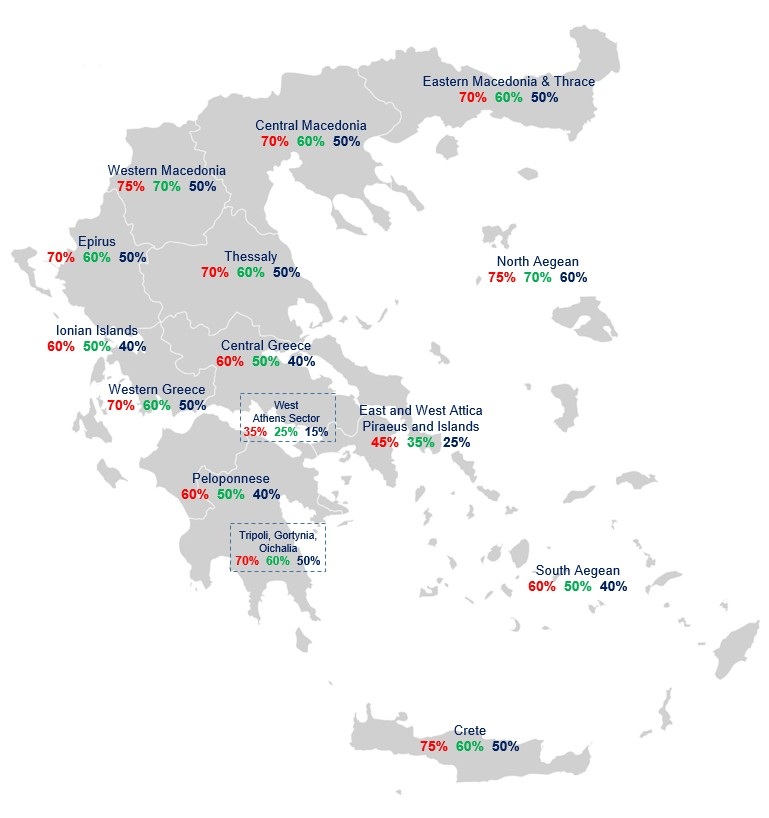
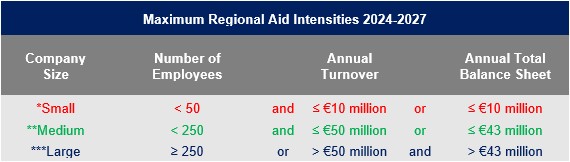
Aid intensities are determined according to the size of the undertaking and the region in which the investment is carried out. The principal distinctions are as follows:
Specific Rules by Type of Incentive
- For micro, small and medium-sized enterprises, all incentives other than the grant are awarded at the maximum rate provided for in the Regional Aid Map (RAM).
- The grant, however, is awarded at 80% of the maximum RAM rate.
In special categories of investment projects, the grant may reach 90% or 100% of the maximum RAM rate.
Large Enterprises
Incentives are awarded at 80% of the applicable maximum rate, except in the case of special categories of investment projects, where they may reach 100% of the maximum RAM rate.
Aid for Special Categories of Investment Projects
Increased aid rates apply to investment projects that:
- are implemented in mountainous areas, excluding the urban agglomerations of Attica
- are located in border areas, within a distance of up to 30 km from the border
- are located on small islands with fewer than 3,100 inhabitants
- concern the reopening of an inactive industrial unit, provided that the fixed equipment of the former unit accounts for at least 50% of the total investment cost.
Specific Rules for Primary Agricultural Production
Different aid rates apply to investment projects in primary agricultural production, instead of the rates provided for in the Regional Aid Map.
The maximum aid intensity is:
- 50% of eligible expenditure for investments carried out in all Regions of Greece other than Attica;
- 40% of eligible expenditure for investments carried out in the Region of Attica;
- up to 60% of eligible expenditure for investments implemented by farmers aged up to 40 years or on small Aegean islands, namely all islands other than Crete and Evia.
The maximum amount of aid for investment projects in primary agricultural production may not exceed €600,000 per investment project and per undertaking.
Maximum Aid Amount
The maximum amount of aid that may be granted to an individual investment project is €20,000,000.
For investment projects in primary agricultural production, the maximum amount of aid is limited to €600,000 per investment project and per undertaking.
Forms of Aid
The following forms of aid are available for investment projects included under this scheme:
- Tax exemption, namely exemption from the payment of corporate income tax on the undertaking’s profits, up to the amount of the approved aid.
- Grant, namely a non-repayable financial contribution from the State covering part of the investment project’s eligible expenditure.
- Financial leasing subsidy, covering part of the lease instalments payable for the acquisition of new machinery and other equipment. The subsidy may be granted for a period of up to seven years following completion of the investment.
- Subsidy for the cost of newly created employment, covering part of the wage costs of the new jobs created as part of the investment, provided that those jobs are not supported under another aid scheme or programme.
The tax exemption, grant and financial leasing subsidy may be awarded either individually or in combination, subject to the specific restrictions set out in the call for applications. The subsidy for the cost of newly created employment is awarded on a stand-alone basis.
Large enterprises are eligible for all the above incentives except the grant. In addition, for micro, small and medium-sized enterprises, with respect to the part of the project constituting a conventional investment, either the grant or the tax exemption must be selected; the two may not be combined.
Main Categories of Eligible Expenditure under Regional Aid
The eligible expenditure of investment projects for which regional aid may be granted includes the following main categories:
- Investment Expenditure in Tangible Assets
This category mainly includes the following:
Buildings and structures: Eligible expenditure includes the construction, extension and modernisation of buildings, special-purpose and ancillary facilities, landscaping works, as well as accessibility works for persons with disabilities.
Restriction: Expenditure on buildings and structures may not exceed 45% of the total eligible regional-aid expenditure. This ceiling is increased to 60% for greenhouse crop-production investment projects and to 80% for investments implemented in listed buildings.
Acquisition of existing fixed assets — SMEs only: Funding may be granted for the acquisition of buildings, machinery and equipment belonging to closed or inactive business establishments, provided that all of the following conditions are met:
- the establishment has closed or would have closed had it not been purchased
- the acquisition is made from a third party unrelated to the purchaser, except in specific cases involving the takeover of a small enterprise by a family member of the original owner or by one of its employees
- the transaction is carried out at market value and any aid previously granted in respect of the same assets is deducted.
New machinery and equipment: This includes the purchase and installation of new technological equipment, internal transport equipment used within the production facility, and technical installations.
Machinery leasing — financial leasing: Lease payments for new equipment are eligible, provided that ownership of the equipment is transferred to the investor upon expiry of the lease.
Modernisation of special-purpose facilities: Expenditure relating to the modernisation of specialised production or mechanical installations not directly associated with building infrastructure is also eligible.
Milk-cooling tanks: These are eligible for units engaged in milk handling and the production of dairy products.
2. Investment Expenditure in Intangible Assets
Expenditure relating to the technological upgrading, organisation and operational improvement of the enterprise is eligible.
More specifically, this includes:
Technology transfer: Expenditure for the acquisition of intellectual property rights, licences, patents, know-how and unpatented technical knowledge.
Quality assurance and quality-control systems: Expenditure for certification systems, software, and systems relating to the organisation and internal operation of the enterprise. Expenditure incurred for compliance with mandatory standards is not eligible.
For expenditure on intangible assets to be eligible, all of the following conditions must be met:
- Exclusive use: The assets must be used exclusively at the establishment receiving the aid.
- Link to the investment: The assets must remain associated with the investment project and be retained among the fixed assets of the enterprise throughout the period during which the long-term obligations apply.
- Depreciable assets: The assets must be recorded as depreciable assets in the accounts of the enterprise.
- Acquisition from independent third parties: The assets must be purchased on market terms from suppliers unrelated to the investment entity.
Percentage limits
For large enterprises, expenditure on intangible assets may not exceed 30% of the total eligible regional-aid expenditure.
For small and medium-sized enterprises, the corresponding maximum percentage is 50%.
3. Wage Costs of Newly Created Jobs
The wage costs of new jobs created as a direct result of the initial investment are eligible. These costs are calculated over a period of two years from the date on which each job is created.
This category of expenditure is supported on a stand-alone basis and may not be combined with expenditure on tangible or intangible assets. In addition, the investment must result in a genuine net increase in employment compared with the average employment level during the preceding 12-month period.
The new jobs must be filled within three years of the completion of the investment and the commencement of productive operation. They must then be maintained for at least:
- five years in the case of large enterprises
- four years in the case of medium-sized enterprises
- three years in the case of small enterprises.
Specific Restrictions for Primary Agricultural Production
Certain specific rules apply to investment projects in primary agricultural production. The following expenditure is not eligible:
- the acquisition of existing fixed assets of an establishment
- the modernisation of special-purpose facilities not related to buildings
- technology-transfer expenditure.
In addition, for crop-production investment projects, expenditure on agricultural tractors and cultivation implements may not exceed 40% of the total eligible investment cost.
Main Categories of Eligible Expenditure Outside the Scope of Regional Aid
Expenditure falling outside the scope of regional aid is subject to different eligibility conditions and aid intensities. It applies to investment projects concerning the processing of agricultural products, as well as to the processing component of vertically integrated investment projects. It does not apply to the part of an investment project relating to primary agricultural production.
The following categories of expenditure are included:
Consultancy services for SMEs:
These include the cost of studies and fees paid to external consultants in connection with investment projects undertaken by newly established small and medium-sized enterprises. Services of a routine or recurring nature, such as standard tax, legal or advertising services, are not eligible.
Energy-efficiency measures:
Eligible expenditure includes the additional investment costs required to achieve a higher level of energy efficiency, excluding energy-efficiency measures relating to buildings. Expenditure not directly linked to this objective is not eligible. Investments undertaken solely to ensure compliance with Union standards that have already entered into force are also excluded from aid.
Installation of efficient district heating and cooling systems:
Eligible expenditure includes the construction, extension or upgrading of energy-efficient district heating and cooling systems. Where the system does not become fully efficient as a result of the initial works, the additional interventions required must commence within three years of the start of the aided works on the distribution network.
Participation of SMEs in trade fairs:
Eligible expenditure includes the cost of renting, setting up and operating a stand for the enterprise’s participation in a trade fair.
Investment aid for SMEs:
This includes expenditure on tangible and intangible assets, as well as the wage costs of new jobs created directly by the investment, calculated over a two-year period.
Unlike the previous aid scheme, the present call does not include, among expenditure outside the scope of regional aid, costs relating to the remediation of environmental damage, the transition to a circular economy, vocational training, or the recruitment of disadvantaged workers and workers with disabilities.
Ineligible Expenditure
The following expenditure is not eligible:
- operating costs associated with the investment and, more generally, any form of operating expenditure;
- the purchase of office furniture and equipment, unless they constitute an essential part of the production equipment
- the purchase of passenger vehicles with up to six seats
- the purchase of plots, land and agricultural parcels. Where buildings are acquired, the portion of the purchase price corresponding to the value of the underlying land is not eligible
- contributions in kind to the share capital in the form of real estate, machinery or other fixed assets
- the construction or extension of buildings on land not owned by the investment entity, unless the land has been granted by the State or another General Government entity, leased from a public or private entity, or is subject to a right of superficies.
In the case of a lease or a right of superficies, its duration must cover the entire period during which the long-term obligations apply, plus an additional four years from the certified date of completion of the investment. A lease may also be concluded by means of a private agreement, provided that it is declared electronically to the Independent Authority for Public Revenue and is duly registered with the competent Land Registry Office or entered in the Hellenic Cadastre.
Additional categories of ineligible expenditure apply to investment projects in primary agricultural production, in accordance with the sector-specific regulatory framework.
Scored Evaluation Criteria
The scored evaluation criteria under the aid scheme “Agri-food – Primary Production and Processing of Agricultural Products – Fisheries – Aquaculture” are divided into four groups. The maximum overall score is 100 points. To be included in the ranking lists, an investment project must obtain at least 50 points.
Group A: Assessment of Investment Project Maturity — 0 to 40 points
The assessment examines evidence demonstrating the project’s readiness for implementation, including:
- the immediate availability of the investment site
- the submission of an application for environmental permittingthe submission of an application for preliminary approval or issuance of a building permit
- the submission of an application for an installation permit
- whether the investment is located within an organised business-reception area or outside such an area.
Higher scores are awarded to projects implemented within organised business-reception areas, such as Industrial Areas, Industrial and Business Parks, technology parks and innovation zones.
Group B: Assessment of the Investment Entity’s Financial Data — 0 to 25 points
The assessment is based on the financial data of the investment entity and is carried out using financial ratios.
For the calculation of these ratios, the average financial figures for the two most recently completed financial years are taken into account. To receive a score under this group, the entity must have recorded turnover exceeding €100,000 in the most recently completed financial year.
In the case of a newly established entity, the assessment may be based on the financial data of its shareholders or partners, subject to the specific conditions set out in the call.
Group C: Assessment of Sustainable Development Criteria — 0 to 20 points
The Group C score is based on criteria directly linked to the agri-food nature of the investment, in particular:
- Production or standardisation of products under recognised quality schemes: The assessment takes into account the production of products designated as Protected Designation of Origin (PDO), Protected Geographical Indication (PGI) or Traditional Speciality Guaranteed (TSG). A duly substantiated intention by the entity to obtain certification under the relevant schemes is also scored.
- Organic products: The production, or intended production and standardisation, of certified organic products is assessed.
- Export-orientation indicator: This is calculated on the basis of the average percentage of the enterprise’s exports during the two most recently completed financial years preceding submission of the application. The higher the export percentage, the higher the score awarded.
Group D: Assessment of Employment Growth — 0 to 15 points
The score under this group is based on the number of new permanent salaried positions expected to be created following completion of the investment, in relation to the total eligible cost of the investment project.
The greater the number of new jobs created relative to the project budget, the higher the score awarded.
Application Period, Submission Procedure and Implementation Period for Investment Projects
The application period for the inclusion of investment projects under this scheme opens on 3 August 2026 and closes on 30 November 2026. Applications must be submitted electronically through the Development Laws Information System (PS-An).
Applications for all investment projects must be submitted to the General Directorate for Development Laws and Foreign Direct Investment of the General Secretariat for Private Investments of the Ministry of Development. Accordingly, under this scheme, there is no provision for the separate submission of investment projects to the Directorate of Private Investments of the Macedonia–Thrace Sector.
The deadline for completion of each investment project is specified in the relevant inclusion decision. This deadline may be extended once, for a period of up to two years, provided that the relevant request is submitted electronically before the expiry of the original deadline and that the required proportion of the project’s physical and financial scope has been implemented. An extension may also be granted on grounds of force majeure, for a period equal to the duration of the interruption or delay, provided that the request is submitted within the applicable deadline and is accompanied by the required supporting documentation.
For further information regarding the new aid scheme “Agri-food – Primary Production and Processing of Agricultural Products – Fisheries – Aquaculture” under the revised Development Law 4887/2022, as well as the planning of your investment projects, please contact us at +30 2310 552000 or +30 210 9580000, or by email at [email protected].